GODONNA (part one)
Reviewing Confessions II, the latest album from Madonna.

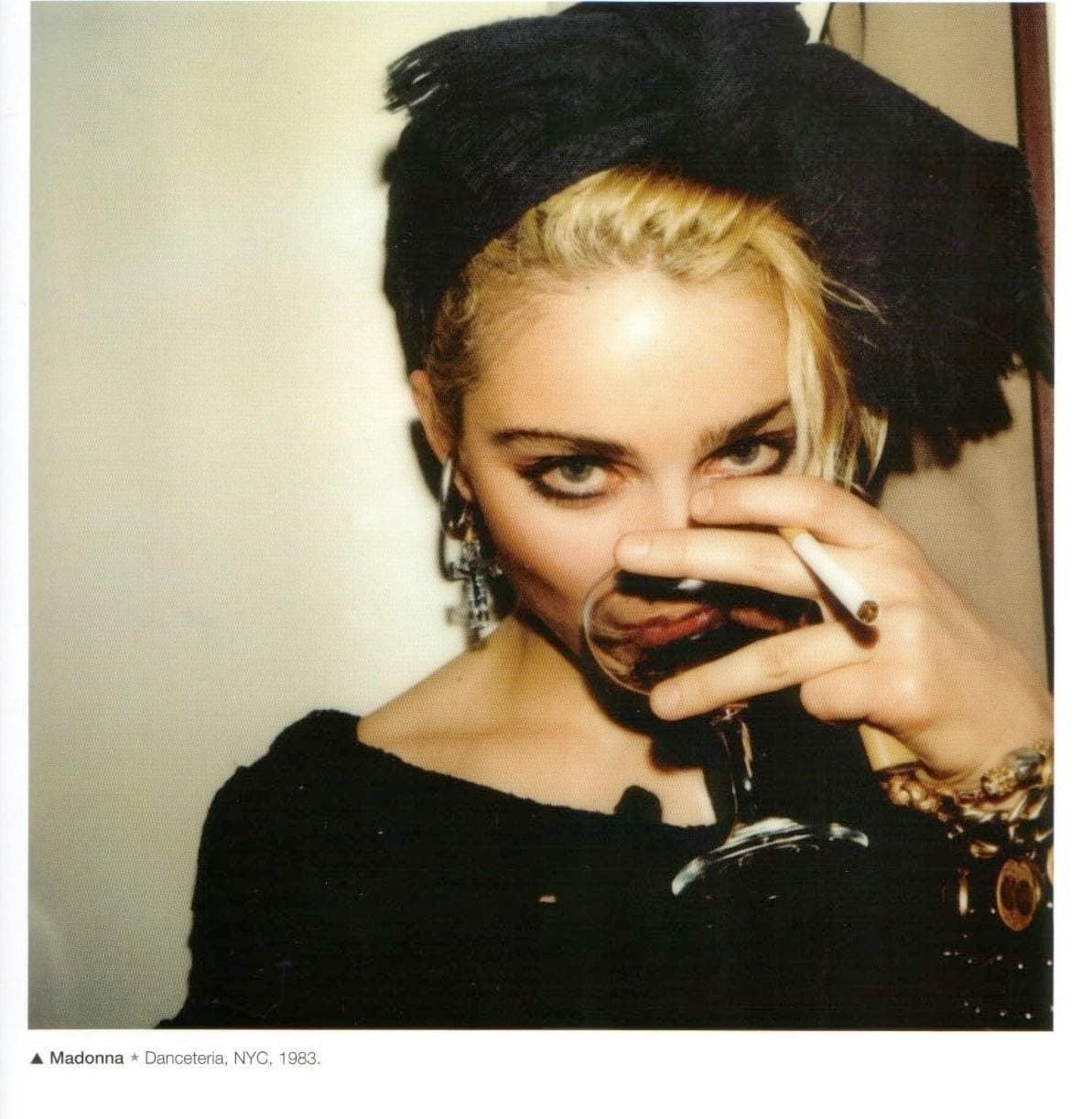
This is the first in a two-part series of posts about Madonna. This initial piece is a review of her new album Confessions II, released earlier this month on July 3rd; the second part will compile some of my favorite Madonna songs and performances for the Madonna-curious among us.
Lurking in the corner of every dancefloor is the anxiety of time. It’s intrinsic to music itself, to dance, defined as these artistic disciplines are by time signatures, rhythms, tempos, beats. What is a pas de deux between two dancers if not an interpretation of the clock—biological or otherwise—sliding forward, a pop song or a piece of chamber music an aesthetic attempt at pinning down an emotion, a feeling, before it dissipates completely? Students of these artforms understand this relationship well; when practicing, every strike of the metronome brings with it a moment of unease, a sense of memento mori: remember, you will die.
Like no other pop star before or after her, time is, for Madonna, of the essence, a subject name-checked and referenced relentlessly across the whole of her forty-plus-year career. “Tick-tock, tick-tock, tick-tock,” she chants playfully, like Alice’s white rabbit, across the late-breaking hit of my teenage years, “4 Minutes,” released as she turned fifty and the surprise subject of many a viral American high school marching band performance uploaded to the nascent YouTube in 2008. “Are you wasting my time?” she demands nineteen years earlier in 1989’s Prince collaboration, “Love Song,” from her chart-topping fourth studio album Like A Prayer, before going on to sing a line she’d repurpose some two decades later, in 2005’s divine, ABBA-sampling slice of pop perfection, “Hung Up”: “Time goes by so slowly for those who wait…” Madonna, to be clear, doesn’t wait—she creates. And time bends itself around her, snapping backwards and forwards like fingers keeping pace.
Now, with the release earlier this month of Confessions II, her first album in seven years, the 67-year-old Queen of Pop has created something virtually unheard of for an artist of her age and stature: a return to relevancy. Public tastes are fickle. Most pop stars sink quickly into irrelevance, into the bloat of legacy, after, at most, five to ten years. But Madonna is the queen of reinvention, the originator of what today’s small-minded excuses for pop stars—Taylor Swift, I’m looking at you—have corporatized into that turgid term called “eras.” Confessions II succeeds by doing something that Madonna swore she’d never do, and that’s going back in time, starting with the album’s title, a sly sequential wink to 2005’s Confessions on a Dance Floor, widely-regarded by both fans and critics to be Madonna’s last truly great and cohesive album before the mess that were the 2010s records recorded under and released by Interscope.
Confessions II, a return to Warner Brothers, moves past the disco inspiration that fueled the first Confessions and instead dives into something murkier. By the end of its sixteen songs, the album becomes a kind of time capsule, the past fusing with present via quotations from Madonna’s back catalogue, samples from influential eighties and nineties house music, and a lyrical focus on her early career. We are left with a record that celebrates the eternity of the dancefloor and the escape it provides its denizens while reflecting back, tenderly, bittersweetly, on the Lower East Side girl Madonna once was, and the eighties New York bohemia that launched her.
Above: Madonna during the first Confessions era, performing a Stuart Price remix of her first single, “Everybody,” the song that started it all.
If you’ve been reading this newsletter for a while, or if you know me in real life, you’ll know that I’m a massive Madonna fan. The title of this piece comes from a joke from a friend who is fond of remarking, whenever I launch into one of my Madonna-related rambles, that I really ought to be saving it for an anonymous fan Twitter account, one that he dubs “@Godonna69.” My first encounter with her musical output came when I was a young child in the nineties, when at an elementary school roller rink party—was it someone’s birthday? A celebration for the end of the school year? The memory is only a fragment; I can’t remember—the video for “Frozen,” the first single from 1998’s Ray of Light (recorded shortly after Madonna gave birth to her first child, Lourdes Leon), was projected on the rink’s wall. I remember, distinctly, feeling transfixed by this witchy woman, the mysterious humming that characterized the song’s Middle Eastern-inflected chorus and her dance across the video’s barren, blue-colored desert as she transformed, alternately, into a flock of crows, a black dog, and, once again, herself.
Four years later (an eternity in the mind of a child), another memory, tied to another one of Madonna’s transformations: “I do yoga and Pilates and the room is full of hotties,” Madonna raps sarcastically in her controversial single “American Life,” released as a protest against the American invasion of Iraq. The media’s reaction to this single was to completely and purposefully misread the very clear sense of camp present in this unbelievably arch song, but once again I—now twelve, and going through puberty in George Bush’s America, where a cruel sense of tackiness, of moral bankruptcy trussed up in the disposable, plastic language of twenty-first century jingoism, reigned—was enthralled. Madonna was conveying something important, I could tell.
I always liked her. In college, we played “Vogue” at parties, some twenty years after its initial release; she was still relevant, at least among the Smithies. Later, in my early thirties, after a particularly terrible breakup, I read the cultural historian Mary Gabriel’s biography of her, Madonna: A Rebel Life, and became obsessed with her 1992 album about love, loss, and sex in New York City, Erotica. This led to an even deeper dive into her discography, and I ended up getting a last-minute (incredible) ticket off StubHub to her Celebration Tour in January of 2024, mere months after Madonna had emerged from a forty-eight-hour coma and nearly died of sepsis.
Miraculously, she was dancing pretty fluidly for a woman of her age and level of dance-related injuries, and I left Madison Square Garden feeling a bit like something had healed within me. It was a good crowd. To my left sat a middle-aged gay man who told me he had been to every one of her tours since Blond Ambition in 1990; to my right, a straight couple from New Jersey, who told me they had won their tickets on the radio. Behind me, some of my fellow millennials freaked out over “Hung Up,” from the first Confessions; in front of me, two mothers cheered with their elementary-aged kids, who knew every word to every song, even some of the racier ones. “Music,” Madonna sings wryly in her 2000 single of the same name, “makes the people come together….the bourgeoisie and the rebel.” That was true that night of Madonna, too.
Listening to Confessions II, then, was an emotional experience for me. I was excited about the initial songs teased by her and Stuart Price (a longtime collaborator of hers, who, among other triumphs, produced Confessions on a Dance Floor and re-mixed her 1983 single “Holiday” with Stardust’s “Music Sounds Better With You” on the 2001 Drowned World Tour, a tour incidentally named after a J. G. Ballard novel I keep meaning to read). “I Feel So Free” sampled the 1989 Chicago house track “French Kiss” by Lil Louis and featured a return to Madonna’s spoken word vocal stylings, which she frequently experimented with in the Erotica era (as heard in, say, 1990’s “Justify My Love,” the video of which was banned from MTV due to the eroticism of its imagery). “Bring Your Love” was poppier and more commercial—it features Gen Z pop star du jour Sabrina Carpenter in a marketing attempt to engage younger audiences—but still fun, with a nice anti-social media message, and “Love Sensation” made me want to smile and dance and smell some fresh flowers.
I was not prepared, though, for the record’s elegiac tone, its sense of looking back and re-examining the contours of a life. “Fragile,” euphoric and trance-inspired, poignantly looks back at the life of Christopher Ciccone, Madonna’s younger brother, who served as an early backup dancer and artistic director for some of her most famous tours, including 1990’s Blond Ambition, before becoming addicted to cocaine, having what Madonna in the song terms “a nervous breakdown,” and writing a painful tell-all that led to a fallout between the siblings before his death in 2024. “Bizarre”—probably my least favorite song on the record; I’m not an EDM fan but I acknowledge it’s a smart move for her to occasionally tap into that market—reflects on her marriage in the eighties to the actor Sean Penn, a relationship for many years trailed by whispers of emotional and physical abuse. It is disquieting, listening to this as a woman who has in the past taken strength from Madonna’s music, and realizing that even when someone has moved beyond the events of her past physically, she can still, forty years later, be ensnared by them emotionally. This is true, too, of one of my favorite tracks from the album, “Betrayal,” a downtempo trip-hop inspired song that samples Erik Satie’s 1893 piano piece “Gnossienne No. 1” and delves into Madonna’s still-complicated feelings towards her stepmother, who also passed away in 2024, a month before Christopher.
Death in fact haunts this record, even in its most dizzying moments of dance-fueled joy. The infectious anthem “Danceteria,” named after the influential downtown club where Madonna first performed live, namechecks Madonna’s origin story and the people she knew in those early days, many of whom are now dead. There are famous figures referenced—Fab Five Freddie, David Byrne, Nile Rodgers, Basquiat (who she dated, and broke up with due to his heroin addiction)—but there are lesser-known names, too, like Debi Mazar, her longtime close friend who she met in the Danceteria elevator. There’s Martin Burgoyne, another one of her best friends and arguably one of the most influential people in Madonna’s life; he died at 23 of AIDS in 1986, with a devastated Madonna paying for his medical bills following her rapid rise to fame. The presence of AIDS, and the devastation it wrought on the gay community in New York and the American cultural scene as a whole, lurks off-stage, never mentioned and yet infusing the song, and our understanding of Madonna’s life and career. Another name mentioned in “Danceteria”: Haoui Montaug, the club’s doorman, whose No Entiendes cabaret gave Madonna her first live performance (and who committed suicide in 1991 following his own AIDS diagnosis).
Above: The lyric video to “Danceteria,” followed by video of Madonna’s first performance of “Everybody” at No Entiendes at Danceteria in 1982. The man in the top hat announcing her at the beginning is Haoui Montaug.
On the dancefloor of C’Mon Everybody in Bed-Stuy, where a friend and I went to celebrate the album’s midnight release, “Danceteria” was greeted with a particular wild joy from the crowd. “Everybody get up and dance!” we all chanted together, the entire club jumping up and down to this line in particular. There was something especially poignant to listening to this song in a gay bar in New York in 2026, in an era in which the threat of AIDS has, miraculously, been defanged by the invention of PrEP. And poignant, too, to be in New York, a city that infuses this record, an alluring city of creative possibility—and yet also an exhausting city, a city of casual cruelties and despairs. If you’ve worked in the arts and media in New York like I have, you always hear about this lost era of downtown New York. Sometimes it’s irritating, knowing that by mere virtue of being born in a later decade, you’ve experienced a different, sometimes more difficult—certainly, a more expensive—city. But that night on the dancefloor, it felt like time’s borders were collapsing. A sense of freedom prevailed.
Slipping into bed that night, I pulled my headphones on to listen to the last few songs on the record, the ones played after we left the bar to go to sleep at a reasonable hour. They were lovely, some of my favorites on the album, following the sinuous “School” and perfect “Love Without Words”: the aforementioned “Betrayal,” the sexy “My Sins Are My Savior,” featuring the Belgian musician Stromae, and “The Test,” with Madonna’s daughter Lourdes, who has a technically richer voice than her mother but lacks charisma, a lesson in the mystery that is the it factor. But it was the final song on the album, “L.E.S. Girl,” that made me cry. I cry every time I listen to it, even now, three weeks later. I think I always will, even in the future.
It is slow, this song, a ballad. Madonna’s vocals are quiet, tender, as she describes the girl she once was, broke and living on Avenue B, a cracked mirror in her hand as she hastily applies her makeup and runs out the door. She is hungry for experience; she is as yet unformed. She is trying to get over a love affair with a nameless man; the listener gets the sense that the man in question is less ambitious than her, or ambitious in a different way, that he wants something different out of life; she is in the process of being formed. It is blue-tinged, lavender-colored; the blue hour of evening, the timid hours of early morning. These in-between hours, when one feels most alive and yet fearful. These ambiguous hours of the day. “Everything fades away,” Madonna repeats. What would have happened if she had stayed chasing after this Lower East Side boy, instead of becoming the Madonna we know today? If she had muted herself but remained in love. Is that love, for women? The only love a still-misogynistic world allows us?
It is disturbing, this song. It has the aura of a swan song. Listening to it, I wondered if this was her goodbye. If this will be her last record. Even Madonna, someday, will die. It is unsettling to listen to this song and remember that a life’s narrative does not wrap up neatly in a bow. There will be regrets. Paths not taken. The things you leave behind in order to make something of your life. “I wasn’t meant for you,” Madonna whispers to this nameless man.
That line again: “Everything fades away,” she repeats. “Everything fades away.” When she first sings it in this song, her attention is directed to the girl she used to be. That Lower East Side girl. Her fragilities, her triumphs. That moment of becoming. “Everything fades away. Except for you.”