Culture Diary: July
Everything I read, watched, looked at, and listened to in July 2025.

Late at night on the last day of July, as I rode the A train back home following dinner with a friend, I saw something that struck me as unusual: a youngish person reading a physical newspaper. It’s not strange to see people under the age of, say, forty-five reading physical books on the train, but a periodical—and not just that, but a daily newspaper—I realized, has become far less common. A few days later, when I mentioned this to a different set of friends as we sat in Prospect Park, one told me that she had recently begun subscribing to the physical weekend edition of The New York Times, something that I have been thinking about doing myself.
Three is a trend!, goes the adage. How to maintain a balance between digital and real life is something I have been considering with some frequency as of late, in both work, my writing, and my personal life. I wrote a bit about the endless “pivot to video” that media as an industry seems to be ricocheting towards earlier this month, and though I don’t think the internet is going away anytime soon—and truthfully, I wouldn’t want it to—I do wonder if the tedium of online life is beginning to wear at us, if the small pockets of people embracing flip phones and print subscriptions indicate that a minor backlash is in the works. But I have to admit: some of the books I read this month were ingested via PDFs on my e-reader.

Books
1. Madonna: Like An Icon, Lucy O’Brien
I’m an obsessive Madonna fan, a passion that has existed since probably the first time I became aware of her—at an elementary school end-of-year roller rink celebration in which I recall skating pensively by myself as the video for “Frozen” played, projected on a wall—but especially since reading Mary Gabriel’s massive biography, Madonna: A Rebel Life, reignited my interest in late 2023. This 2007 biography by the British music journalist Lucy O’Brien is smart and offers some excellent original reporting and interviews, but occasionally O’Brien can get a little uneasy with some of Madonna’s more outré explorations of sexuality. As I read it, I thought back to a piece of analysis that Gabriel offered in her own biographical take on the pop star: that her earth mother Ray of Light persona, while beautiful and paired with one of her most cohesive and musically forward-thinking albums, was also popular precisely because it offered the public a return to a less threatening, less sexual and less political, version of Madonna. (I still love that the album is having something of a pop culture revival lately, though.)
2. Death and the Gardener, Georgi Gospodinov (translated by Angela Rodel)
This new novel by the Bulgarian writer Georgi Gospodinov is forthcoming in October, and I’m writing a review of it. More in the future!
3. The Body Digital: A Brief History of Humans and Machines from Cuckoo Clocks to ChatGPT, Vanessa Chang
An interesting history of the ties between technology and the human body, forthcoming from Melville House in November. I loved the chapters that delved into the history of clocks and automatons (no surprise there), but the last chapter, when Chang tried to bring in some arguments about A.I. and writing, was disappointing, drawing on brief selections and ideas from some science fiction authors but not really engaging with a broader history and theory of literature aside from one or two extremely brief asides about the compression of time in Ulysses and Mrs. Dalloway. It could have been much richer.
4. Say Fire, Selma Asotić (translated by the author)
A vivid debut poetry collection by the Bosnian poet Selma Asotić touching on the aftermath of the Yugoslav wars in the nineties, the political valence of fire, legacies of violence, and the meaning of memory. Forthcoming from Archipelago in September, and excellent.
5. In Farthest Seas, Lalla Romano (translated by Brian Robert Moore)
This is a beautiful book by the Italian writer Lalla Romano, juxtaposing the first years of her marriage to her husband, the banker Innocenzo Monti, in the early 1930s with their last days together before his death in 1984. It is a true portrait of intimacy, with its attendant highs and lows, that at times reminded me a little of another twentieth-century Italian writer, Natalia Ginzburg, and her essay about her second husband, “He and I.” Highly recommend—it’s coming out at the end of this month.
6. Life Studies, Robert Lowell
7. For the Union Dead, Robert Lowell
I have a huge soft spot for all those mad midcentury Massachusetts poets that each spent time at Maclean—Robert Lowell, Sylvia Plath, Anne Sexton—and it was enjoyable to reread these two landmark collections for the first time since I was an undergraduate. The way Lowell incorporates the expanse of history and pairs it with the personal, the sense of memory, is so good and, frankly, glamorous.
8. Animal Stories, Kate Zambreno
I generally enjoy everything Kate Zambreno writes, and this book-length essay, forthcoming from Transit in September, is no exception. Touching on the history of zoos, photographs by Garry Winograd of the Bronx Zoo, and the letters and diaries of Franz Kafka, it’s a thought-provoking exploration of the dividing line between the animal and the human.
9. Greyhound, Joanna Pocock
I absolutely loved this travelogue by the Irish Canadian writer Joanna Pocock juxtaposing a road trip through America she took via the Greyhound bus system in 2006 following a series of miscarriages to a recreation of that trip in the post-pandemic U.S. Along the way, she brings in other American road trip memoirs by women including Simone de Beauvoir’s amazing America, Day by Day (which I incidentally earlier this year wrote about briefly in The Atlantic), and writes a fascinating portrait of a country’s slow and steady breakdown. Fair warning, though, it features a scene on the bus detailing one of the worst portrayals of food and eating I’ve read, which my mind is still spiraling over whenever I think back to this book. Forthcoming this month from Soft Skull in the U.S. and Fitzcarraldo in the U.K.
10. Our City That Year, Geetanjali Shree (translated by Daisy Rockwell)
Fantastic novel by the first Hindi-language writer to win the International Booker (for her novel Tomb of Sand, also translated by Rockwell). Our City That Year is a fragmentary work, first published in 2000, that details the rising tensions and outbreaks of violence between the Hindu and Muslim populations of an unnamed city, based loosely on the demolition of the Babri Mosque in the city of Ayodhya in Uttar Pradesh in 1992. This is a book about political violence, and how quickly a city can break apart; Shree is adept at portraying the rush of panic and confusion that leads to neighbors turning against one another. There is a beautiful line towards the end, too, in which the unnamed author narrator observes how fragments—like the fragments of experience and history that she is recording—can knock against each other until sparks fly. Highly recommend, especially in these uncertain political times in the U.S.
11. The Dream Factory: London’s First Playhouse and the Making of William Shakespeare, Daniel Swift
This is forthcoming from FSG in November, and it’s great! Filled with interesting tidbits about the economic prospects of playwrights in Shakespeare’s era (bad!), as well as assorted odd factual asides about the time period (older generations were apparently not happy about the vogue for metal silverware over wood) and great insights into how Shakespeare became Shakespeare (I had no idea how often the playwrights of this era were collaborating with one another, at least in the early stages of their careers, or how exactly apprenticeships shaped the lives of working-class Londoners).
12. Big Kiss Bye Bye, Claire-Louise Bennett
I might be writing about this, stay tuned.
13. Fresh Green Life, Sebastian Castillo
I enjoyed this novel, which came out in June. Moments I thought were particularly compelling: the repetition of names between the author himself, the main character, and the writer who was the subject of the narrator’s professor’s obsession, almost as though to point out the ways in which we attempt to turn our lives into stories. And then, immediately after, the narrator’s confrontation with the young man reading the (unnamed, but obviously) Jordan Peterson book on the train, as though to condemn the particular ways in which certain men construct fantasies and fictions out of their own masculinities. I don’t agree with the Thomas Bernhard comparisons I’ve seen floating around, though; I found the book to be working in a much more meditative mode, without the higher-pitch and frenzied sense of political disgust that characterizes so much of Bernhard’s work.
14. Empire of the Elite: Inside Condé Nast, the Media Dynasty That Reshaped America, Michael M. Gynbaum
I have so many thoughts about this book, virtually none of which I will be recording for posterity’s sake in this newsletter. That being said, I inhaled it, and if you, too, have ever worked in media—or would like to read some excellent gossip about the industry—I recommend.
15. Absence, Issa Quincy
Maybe my favorite book I read this month, an unexpected delight that was sent to me from Two Dollar Radio (it came out in the U.S. earlier this month; I believe Granta is publishing it in the U.K.). It is a book about memory, and loss, and the uncertain ways through which we move in the world. A supremely elegant work in its construction—the way it spools forth is very delicately done—but it’s a hard book to describe. The narrator thinks of a poem his mother recited to him as a child. He thinks back to a time he lived in the U.S. He thinks back to a time he lived in the U.K. He encounters several people, including an old teacher, two brothers lost to opioid addiction in Massachusetts, and an older woman who works for the MBTA and forms an odd friendship with him. Mostly, it is a novel about aching in some way—for the past, for connection, for your sense of self.
Movies
1. Rashomon, Akira Kurosawa (1950)
We saw this during the Kurosawa retrospective at Film Forum, and were both amazed at how packed the theater was on a Monday night. I hadn’t seen any Kurosawa movies before—I know, I know!—but I had once taught the original Akutagawa short story to a class I taught at NYU last year. It’s strange to watch a movie that was so influential so many years after the fact, and to see where all the tropes that have descended from it got their start.
2. This Woman, Alan Zhang (2023)
A lingering shot of a biography of Eric Rohmer in the middle of this film reveals what exactly we’re getting into: this is an at-times disquieting autofictional exploration of the heart, portraying a 35-year-old woman’s attempts to distract herself from motherhood, her job in real estate, and an unfulfilling marriage via a series of affairs. The movie itself was produced and distributed by a Malaysian company so as to avoid the Chinese censorship boards; I streamed it on Metrograph’s at-home channel. Watching it, one is struck by a constant sense of precarity: it feels as though both the character’s home life and the Chinese economy could crash at any time. At the end of the movie, all veneer of fiction dissolves as the actress playing Beibei, the film’s protagonist, breaks character and tells the camera that she worries people will confuse her with the character. A conversation between her and the director—both women, and friends in real life—reveals that the movie is based around real-life affairs and experiences they’ve had outside of their own relationships with husbands and boyfriends. A brief discussion of gender, infidelity, and real life versus fiction ensues. Though I generally enjoyed the film, there was also a deep and aching sadness to it, particularly in this ending.
Performing arts
1. Lowcountry, written by Abby Rosebrock and directed by Jo Bonney
I saw this early in the month with a very good friend who was visiting for the weekend and who knows much more about theater, and the New York theater scene, than I do. We both really enjoyed this play, which was a rather thrilling deconstruction of the whole “heteropessimist” moment that’s been in vogue the last few years, using a first date between two very troubled people as its initial premise. The ending was a little predictable, and a tad too hopeful for me—there’s a Bonnie and Clyde twist that I found slightly too pat—but overall, I thought this was darkly humorous in an appealing and thoughtful way.
Visual arts
1. Doors, Christian Marclay, the Brooklyn Museum
I’m writing about this, more in the future.
2. Telos Tales, Alicja Kwade, Pace Gallery
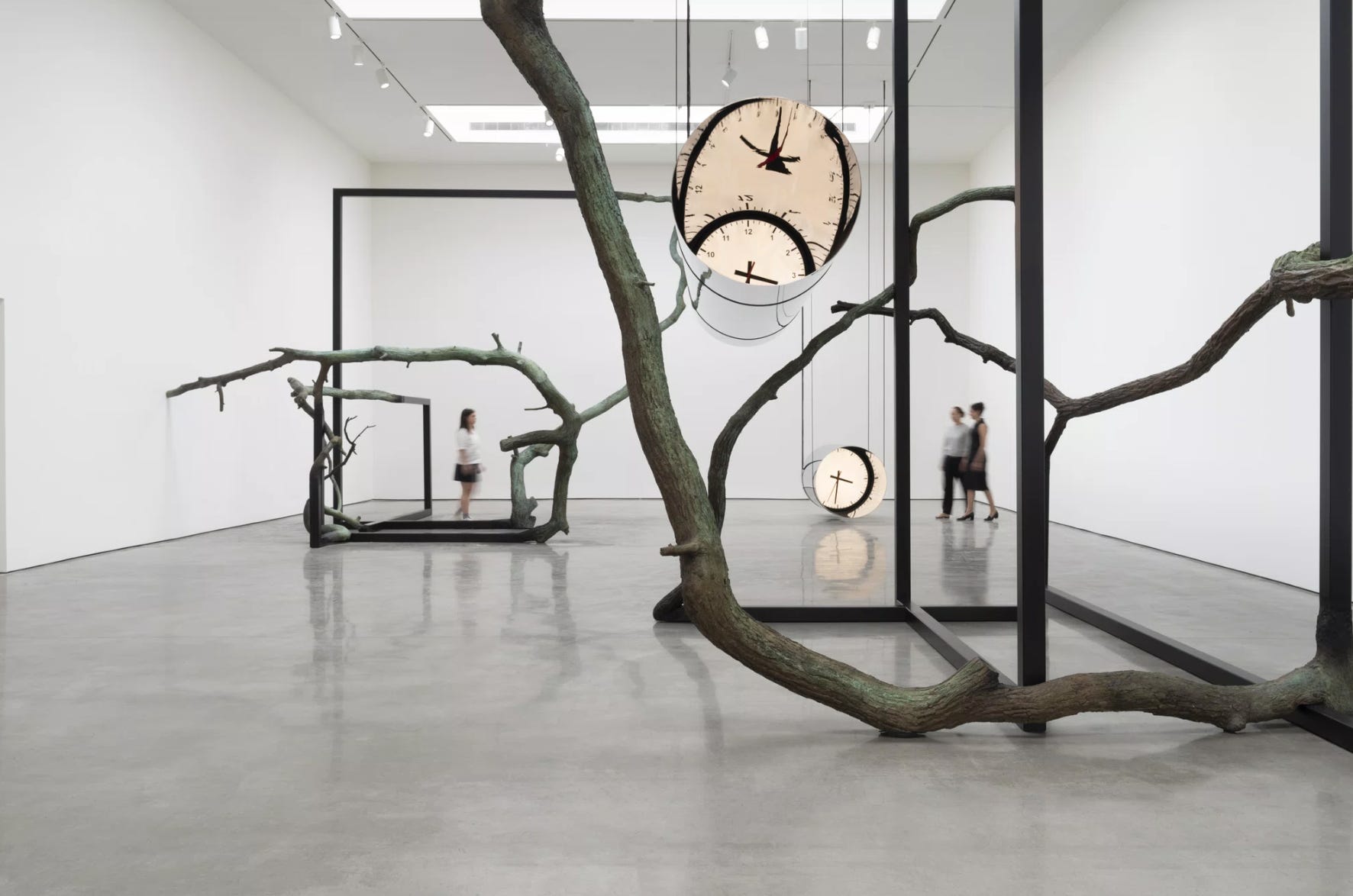
I like seeing a woman artist go big—and these sculptures by the Polish artist Alicja Kwade, featuring a series of clocks and interlocking metallic elements, are enormous. Their size, in fact, is slightly overwhelming, and it makes the experience of staring at their clockfaces into something of a hypnosis. This is on display at Pace through August 15.
3. Constellation: Diane Arbus, at the Park Avenue Armory
Seeing this many Diane Arbus photographs in one place is a dizzying experience. Unfortunately, the way this show is set up also makes it a slightly incoherent one, too. I hated the lack of chronology and context as I drifted through the room (I also disliked the abrupt intrusion of the mirror bisecting the room, and the smaller mirrors scattered among the photos). What could have been an amazing retrospective instead turned into a rather confusing afternoon.
Music
1. Veronica Electronica, Madonna
“‘Gone, Gone, Gone’ is the song of the summer,” I texted a friend while listening to this much-rumored collection of Ray of Light remixes and one unreleased demo (the aforementioned “Gone, Gone, Gone”). (He agreed.) The name of the album comes from the name she originally toyed with calling Ray of Light, and the name she would occasionally use to check into hotels. The William Orbit edit of “Frozen” on this might be even better than the original? I was never going to give this a bad review, sorry.
2. Juggling Dualities, rRoxymore
Very cool synthesis of the organic with the electronic by the French producer rRoxymore (real name Hermione Frank). I read in a profile on Bandcamp that she put it together in six weeks after a long sense of blockage—I love hearing stories like this. (Apparently Goethe wrote The Sorrows of Young Werther in about this span of time, too.)