Culture Diary: December
Everything I read, watched, looked at, and listened to in December 2025.

Farewell, 2025. The first book that I’ve finished so far in this new year is Virginia Woolf’s Mrs. Dalloway, which I spent the morning of January 1st curled up with in my apartment, avoiding the cold. It’s been a few years since I last read it, and my copy is the one I first bought in college for a course I took entirely devoted to the Bloomsbury group. It’s funny to return to well-worn copies of beloved books, and to see what a different version of yourself had underlined in the past. Why, for instance, had a previous me marked, in all capitals, “YES” in the margin near a perfectly ordinary exchange between Clarissa Dalloway and her maid, Lucy? (Puzzling over this, I realized it must have had something to do with the lack of a period at the end of a paragraph, and the way Woolf used this missing punctuation to connote a certain restlessness and sense of movement.)
With this reread—which I undertook because I’ve been thinking about how writers capture cities and walking through cities (a perennial interest of mine), and because I’m superstitious about what the first book I read in a new year will be—many new sentences were underlined by the book’s end. I still marvel at the way Woolf is able to compress so much experience into a single day, the sensitivity with which she writes Septimus Smith and his experiences of the war, and the rhythms of the city that are captured so effectively in the many vivid walks through London that Clarissa and the other characters take. I love, for instance, this line about a crowd of passerby stopping to look at birds flying past while an airplane marks an advertisement for toffee in the sky: “As they looked the whole world became perfectly silent, and a flight of gulls crossed the sky, first one gull leading, then another, and in this extraordinary silence and peace, in this pallor, in this purity, bells struck eleven times, the sound fading up there among the gulls.” To write of something as ordinary, as unpleasantly contemporary, as an advertisement, and in such an artful way, lends such a wonderful ache to the whole encounter—life and its minutes, slipping away.
Books
Last Stops of the Night Journey, Milo De Angelis (translated by Patrizio Ceccagnoli and Susan Stewart)
Archipelago will be releasing this collection by the contemporary Italian poet Milo De Angelis in April, and I found it quite fascinating. Since 1996, De Angelis has taught poetry in a high-security prison outside of Milan, and some of the poems in this book are inspired by this experience, particularly—as an interview with De Angelis at the beginning explains—with a Sicilian man named Franco, imprisoned for killing his wife. As a woman reading these poems (which, to be clear, do not condone this crime in any way), I found myself wrestling at times with the uneasy experience of peering inside the murderer’s head, and hearing his justifications rendered in lines that were both blunt and yet, to a certain extent by sheer virtue of appearing within a poem, aestheticized. This is part of what makes this particular poetic cycle a success, I think: De Angelis does not shy away from the ugliness of violence—and, in doing so, he asks hard questions about human connection and forgiveness.
Beckomberga, Sara Stridsberg (translated by Deborah Bragan-Turner)
I’m writing about this, stay tuned.
At the Threshold of the Image: From Narcissus to Virtual Reality, Andrea Pinotti (translated by John Eaglesham)
I bought this new book of media theory on a whim and thought that Pinotti’s ideas concerning immersion and the digital image, and how virtual reality offers a further potential for this beyond the static relationship between the viewer and the image historically offered by films and paintings, interesting. But will virtual reality really become as popular as some people seem to worry that it will? It mostly just seems kind of cumbersome and provides a solution for a problem that doesn’t actually seem to be much of a problem for the human imagination—confusing real life and fiction. We do it anyway.
The Undiscovered Self, Carl Jung (translated by R. F. C. Hull)
This was sitting on my shelf, unread, for the last few years. It was enjoyable! The first essay is about the individual and self in the age of mass media and consumerism, and the second is about the symbolism of dreams.
What Am I, A Deer?, Polly Barton
I’ll repeat what I wrote in last week’s newsletter about this novel that is coming out from Fitzcarraldo in April: “A really fantastic novel by the writer and translator Polly Barton, whose work I’ve enjoyed for a while now. I won’t say too much here because I’m hoping to write a review of it, but let’s just say I’ve never encountered a novel with so many scenes set in a karaoke bar before.”
The Leopard, Giuseppe Tomasi di Lampedusa (translated by Archibald Colquhoun)
Yes, this is as good as everyone says. The last chapter, in particular, with that leap forward in time, and how clear it becomes the Sicilian aristocracy of the nineteenth and twentieth centuries (a group that Lampedusa was well-acquainted with, since he was one of them) shot themselves in the foot by refusing to modernize in the face of liberalism, Garibaldi, and the unification of Italy. I read it on a long plane ride.
Kingmaker: Pamela Harriman’s Astonishing Life of Power, Seduction, and Intrigue, Sonia Purnell
Another book I read on the plane, and it was perfect for it. This is a biography of Churchill’s ex-daughter-in-law, Pamela Harriman, who, following her divorce from the heinous Randolph Churchill, became a courtesan in Paris and then a power player in U.S. politics after her marriage to the former governor of New York, W. Averell Harriman. Eventually, she became the ambassador to France in the nineties under Clinton. It’s a gossipy page-turner but I must say, Harriman doesn’t exactly come off well in it, though her biographer tries her hardest to explain away some of her more questionable decisions and viewpoints and claims that Harriman was secretly a feminist sympathizer. It’s hard, though, when your subject is on the record as saying how much she dislikes her fellow women…
Movies
When Harry Met Sally…, dir. Rob Reiner
I watched this after the horrible news that Reiner and his wife had been murdered by their son. This is the perfect romantic comedy, one that feels distinctly for and about adults in the same way that Woolf once referred to Middlemarch as “one of the few English novels written for grown-up people.” I love the interviews with real-life couples scattered throughout and the individuality of each love story, which feels refreshing in this age of catchphrases about relationships and matters of the heart. I love that it takes Harry and Sally so long to finally get together, and the ending speech at the New Year’s party gets me every time. There are two New Year’s Eves in my life on which I’ve watched this and timed the chiming of midnight with that scene, both of which led to good years.
Assorted Christmas movies
I’m not going to bore you with my takes on the six different very famous Christmas movies my sister and I watched together over the holidays, but I will say that A Muppet Christmas Carol remains as charming as ever, and the singing Muppet vegetables warbling from various carts as Scrooge storms around London learning about the meaning of Christmas always make me laugh.
Before Sunrise
Before Sunset
Before Midnight, all dir. by Richard Linklater
This year, the way I celebrated New Year’s Eve was getting very dressed up, making raclette, and watching all three of these films. Linklater’s approach to cinematic time and aging is intriguing to me (see, for example, his 2014 film Boyhood, filmed with the same cast over the course of twelve years), and this is also something he explores via the arc of the relationship between Celine and Jesse in these three movies, each filmed a decade apart. I had only previously seen Before Sunrise (earlier this year), which I started off unsure about and thoroughly enjoyed by the end. (As an aside, I loved that it was set on Bloomsday, June 16.) But Before Sunset and Before Midnight were even better, I thought, with my favorite being Before Sunset, when the characters reunite after nine years apart. They are older, a little sharper-edged and hurt by life, and yet still believe in the possibility of love and are willing to go after it. The speech Celine, as played by Julie Delpy, gives in the car about feeling like all her exes treat her like a learning experience is pretty amazing, as is the final scene, when it becomes clear Jesse will miss his flight.
Poking around online, I saw that many viewers of Before Midnight were saddened by it, and the moment of martial crisis it depicts between the now-established couple, but this sense of realism was what made me love it. Both characters come off alternately annoying and sympathetic at different times during the film’s duration, and that feels realistic, too—and that’s what I found so hopeful about the ending, and Jesse’s very moving speech about real life and real love. It’s better than the fairy tale what-if promised by the first film in the trilogy. It’s interesting, too, that these two films were more of a collaborative effort than the first, with both Ethan Hawke and Julie Delpy receiving co-writing credits. There is a tenderness to these movies, and the way they look at and voice both women’s and men’s experiences of and fears and hopes in love, that I appreciated.
Music
Non Fiction: Piano Concerto in Four Movements, Hania Rani and the Manchester Collective
This is a new piece by the Polish pianist and composer Hania Rani, and I thought it was more successful than the live experimental show I saw her perform at Pioneer Works back in October. The lively second movement is my favorite.
Performing arts
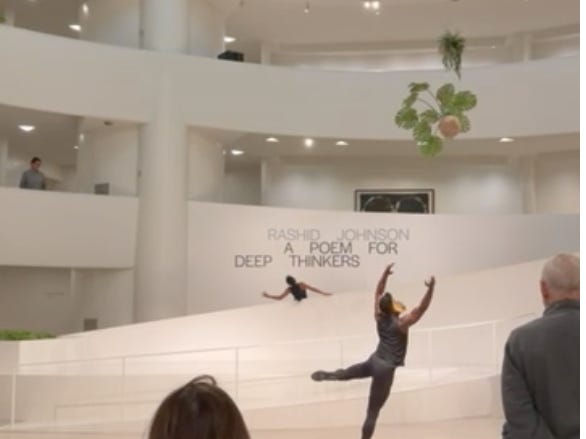
The Hikers, directed by Rashid Johnson and choreographed by Claudia Schreier
A friend scored PR tickets to this contemporary ballet performance held at the Guggenheim in conjunction with the artist Rashid Johnson’s exhibition A Poem for Deep Thinkers, which I saw in November. Based on an experience Johnson had while hiking in Colorado, the piece portrays an unexpected encounter between two people on a trail, and I thought the way the dancers and choreographer incorporated the architecture of the Guggenheim—one moving down the central spiral in slow great steps—was very elegant.